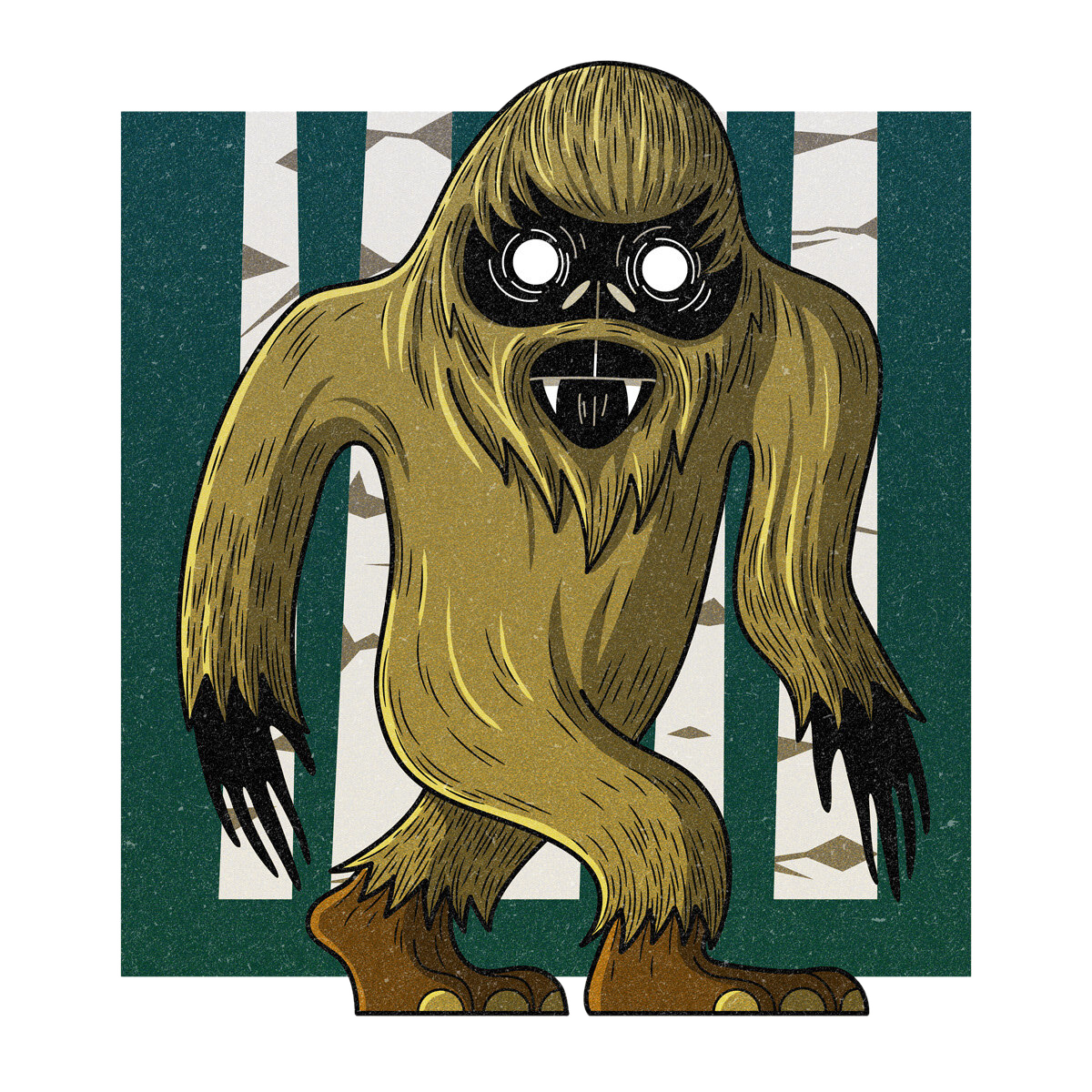
 (opens the full-size plate in a new tab)
Bigfoot
Hominid / Primate
Mainstream zoology attributes the record to hoaxes, pareidolia and upright black bears.
A massive, reclusive hominid boasting a continent-wide footprint, serving as the biological basis for centuries of indigenous legends and modern wilderness sightings.
Etymology. Widely known as Sasquatch, an anglicized version of the Halq'emeylem word 'sasq'ets' meaning 'hairy man', coined in 1929 by J.W. Burns.
Anatomy. It is a massive, muscular, bipedal ape-like creature standing 6 to 9 feet tall. It is covered in dark brown or reddish hair and possesses broad shoulders with no visible neck. Biologically, it leaves massive 16-inch footprints.
Ecology. Primarily inhabits the remote, temperate terrestrial woodlands of the Pacific Northwest and Washington state.
Behavior. A highly elusive omnivore that shies away from humans. However, historical encounters, such as the 1924 Ape Canyon incident, claim they threw large rocks at prospector cabins and exhibited territorial hostility.
Mythology. Tracing its fame back hundreds of years to Native American legends of 'wild men', it became the ultimate North American cryptid. Mainstream science universally dismisses it as a combination of hoaxes, pareidolia, and the misidentification of upright black bears.