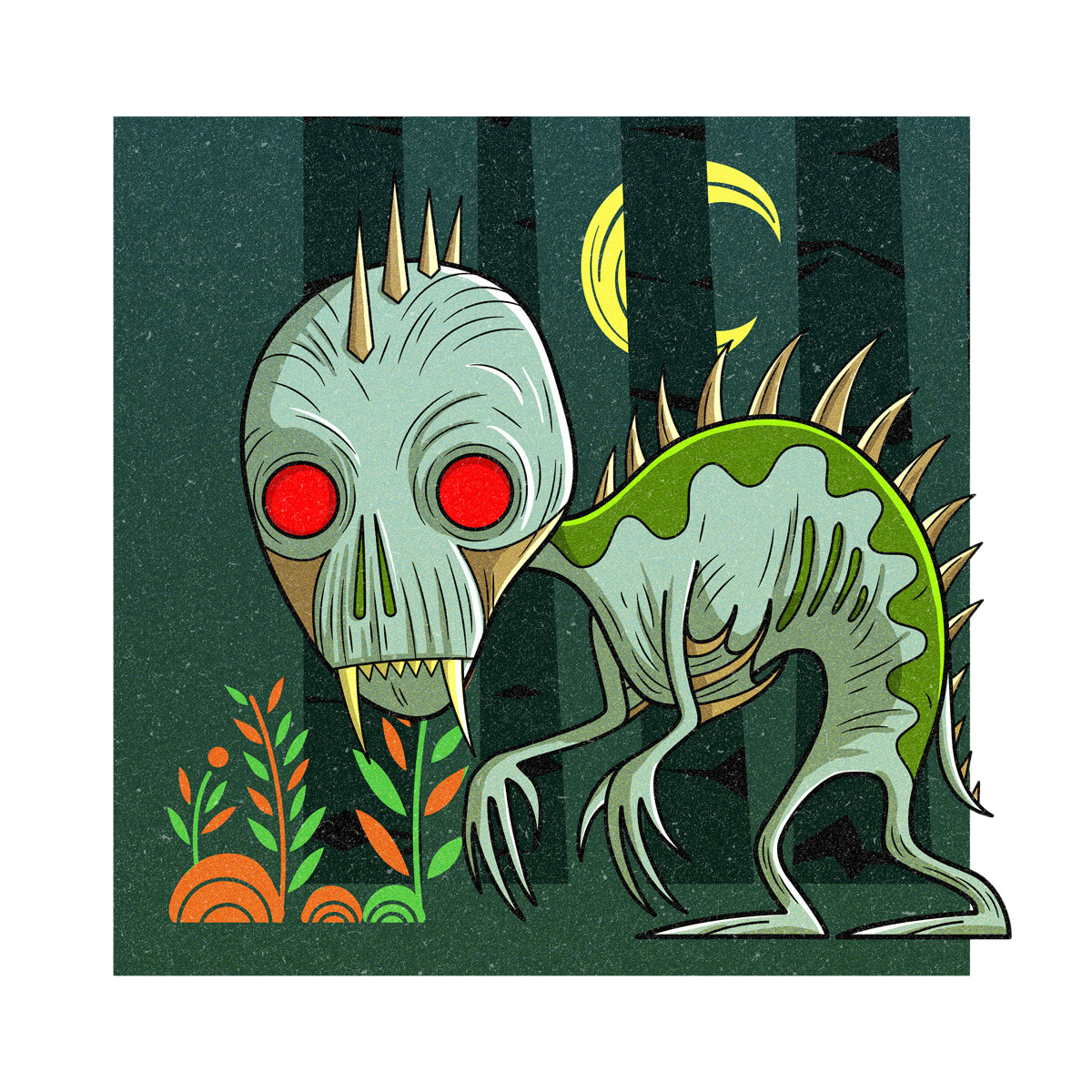
 (opens the full-size plate in a new tab)
Chupacabra
Terrestrial Predator / Mutant Canid
Every carcass submitted for testing has returned coyote or dog with sarcoptic mange.
A vampiric livestock predator whose legend began with science fiction influence in Puerto Rico before evolving into misidentified, parasite-infected canids in the American Southwest.
Etymology. Coined in 1995 by Puerto Rican comedian Silverio Pérez, the name translates literally from Spanish as 'goat-sucker'.
Anatomy. Original 1995 accounts described a reptilian, alien-like biped with sharp dorsal spines. Modern North American variations describe a hairless, quadrupedal wild dog with a pronounced spinal ridge, severe skin thickening, and prominent fangs—symptoms aligning with severe mange.
Ecology. Ranges from Puerto Rico to the Southwestern United States, thriving in areas suffering from frequent, extreme dry seasons.
Behavior. Driven by the weakness of severe parasitic infection, these canids are forced to attack easy, enclosed livestock. They supposedly drain the blood of their victims through distinct puncture wounds.
Mythology. The initial 1995 panic was deeply influenced by the sci-fi horror film 'Species'. By the 2000s, the legend migrated north, where biological analysis of recovered 'chupacabras' consistently proved them to be coyotes or dogs afflicted with severe sarcoptic mange.